
An $80 million estate, but where was the will?
When Aretha Franklin died, no one could find her will. Then two turned up, one in a locked cabinet, one under a couch cushion. The lesson is for the rest of us.
 ··3 min read
There is a story that floats around estate-planning circles about Aretha Franklin.
When she died in 2018, she left behind an estate widely estimated at up to $80 million. But her family could not find her will.
Months passed before her niece found two competing handwritten wills in Franklin’s home.
One was in a locked cabinet. Another was written in a spiral notebook and found…beneath the cushions of a couch.
The documents offered different instructions about who should administer the estate and how Franklin’s property should be divided. Her sons disagreed about which one should govern.
In 2023, a jury accepted the couch document as her most recent valid will.
How does this happen?
Aretha Franklin was a multimillionaire and one of the most celebrated American artists of the twentieth century. She could have hired lawyers, retained a trust company, or just asked an assistant to get the right people in a room.
But her final wishes ended up in a notebook under a couch cushion.
As strange as the story is, the “will-in-the-couch” reflects a common way of thinking: whatever we leave unfinished, we assume, will somehow be worked out by the people who survive us. I have heard this sentiment expressed plainly in conversations with Muslims about estate planning.
I don’t need to worry about what happens after I die. I’ll be gone. The people who survive me will figure it out.
We tell ourselves that our families already know enough. They can call around, track down the passwords, and bring in an accountant or lawyer if things get complicated. In one way or another, they will figure it out.
But the inconvenience we avoid today by putting off preparation for our eventual passing does not disappear. It reappears as work for someone we love, often in the midst of grief.
Our tradition directs us to think differently.
“Be your own executor,” said al-Rabi ibn Khuthaym (d. around 63 AH / 683 CE), an early Kufan scholar of the Tabi’in and a close student of Abdullah ibn Mas’ud.
Al-Rabi’s counsel calls us to sit in the place of the person who will one day settle our affairs, and to do now what we can before someone else is left to do it without us.
The saying was repeated through the early spiritual tradition, recorded in works of counsel, and eventually preserved by al-Maydani (d. 518 AH / 1124 CE) in his collection of proverbs. It became a portable piece of Muslim wisdom because it reaches beyond estate preparation.
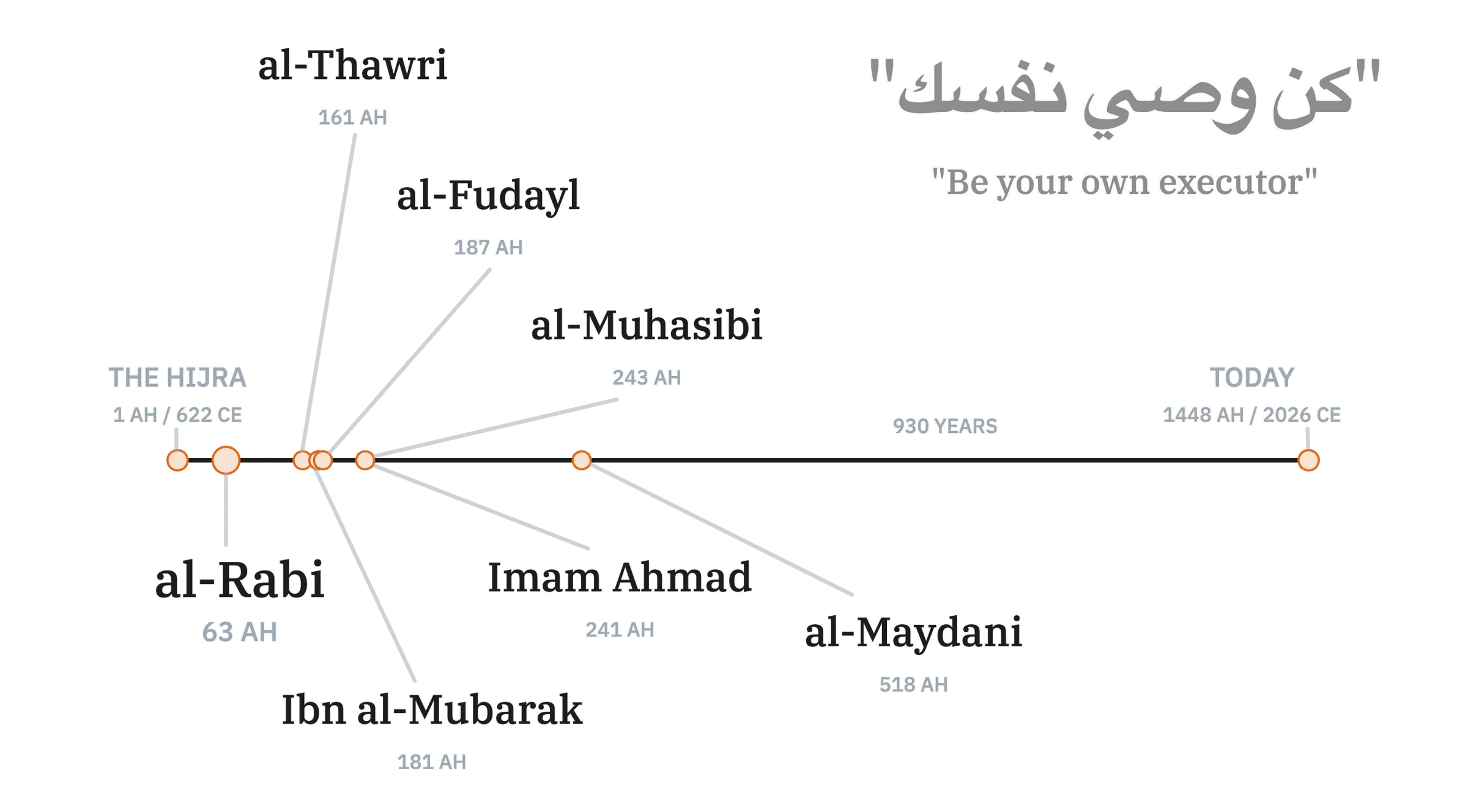
A counsel attributed to al-Rabi ibn Khuthaym, preserved and echoed across five centuries. Sources and parallels: Ahmad ibn Hanbal, al-Zuhd; Ibn Abi al-Dunya, Qasr al-Amal; Abu Nuʿaym, Hilyat al-Awliya; al-Muhasibi, Risalat al-Mustarshidin; al-Maydani, Majma al-Amthal.
Repay the debt now, return the trust, give the charity. Repair what can still be repaired, and clarify what you can clarify. Do not leave the work of your conscience to grieving relatives.
Sit in your executor’s seat today and imagine what they will see after you are gone.
From that seat, things begin to snap into focus.
You see the account no one else knows about, the document whose latest version is unclear, the debt that was never written down, and the instruction that exists only in your head.
No one knows the shape of your affairs better than you do today. Complete the documents, make clear which version is current, and organize the accounts, debts, obligations, and instructions.
Let your executor know where to begin, and give them a head start. Sit in their place today, while the answers are still yours to give.
Be your own executor.
MuslimMoney Letters
Thoughts on money and Muslim life, delivered to your inbox.